First Peoples and First Settlers
There is a strong oral historical tradition indicating that, prior to European contact, Mi'kmaq people set up seasonal fishing and berry-gathering camps on Isle Madame. The oral history also indicates that these camps continued to be used post-contact, though for how long is not clear. Oral tradition also suggests that Basque fishermen may have had a seasonal fishery on the Island in the 1600s, long before any permanent settlement was recorded. No evidence exists, however, to connect these seasonal fishermen to residents of Basque descent who are recorded as having immigrated to Isle Madame at a later period.
Permanent settlement on Isle Madame by those of European descent began sometime in the first part of the 1700s. In 1713, when Acadia was taken by the British and became Nova Scotia, the French governor of Louisbourg invited the Acadians of Nova Scotia to settle on Isle Royale, now known as Cape Breton. By 1734, sixty-seven families had answered the call, though a number returned to Nova Scotia after finding the land inhospitable. Of those who remained, a number settled at Port Toulouse (now St. Peter's). By 1752, French census documents included several Acadian families living in Petit de Grat, where the French fishing firm of D'Aroupet and Hiriat had set up a fishing station. The same census recorded 23 families on the north side of Isle Madame. When Louisbourg and Isle Royale (Cape Breton) fell to the British in 1758, it is not entirely clear what happened to these families. Oral tradition has it that many hid in the woods fearing deportation by the British.
The Jersey Adventurers
Upon the defeat of the French in Quebec in 1763, various British and Channel Island fishing companies began to look to Cape Breton and the Atlantic coast of Quebec to establish operations. By his own account, John Robin, a young sea captain from Jersey, was the first of these "adventurers" to Isle Madame, arriving in the Arichat Harbour in 1764, where he found twelve Acadian families already living there. John's younger brother, Charles, joined him on Isle Madame for the winter of 1767/68, before heading to the Baie de Chaleurs to establish a separate fishing operation there. Charles' account of his winter on Isle Madame indicates that there was a well-established, if thinly spread, population of Acadians living on the Island by that time.
Over the years, the Robin brothers would become responsible for major Channel Island commercial fishing enterprises in Cape Breton and along the Baie de Chaleurs, with John overseeing operations in Cape Breton and Charles based in Paspebiac on the Atlantic shore of Quebec. In the early years of its operations, the company settled deported Acadians from St. Pierre and Miquelon at many of its fish drying stations. While the majority of people employed by the Robins came from the Channel Islands, the company also traded essential supplies and equipment to Acadian fishermen in return for fish. According to John Robin, by 1777, there were thirteen Jersey ships navigated by 300 men operating on Isle Madame, alongside sixty Acadian families who owned fifty eight-ton shallops, all working in the cod fishery.

War and Upheaval
The American War of Independence, which broke out in 1776, brought an enormous disruption to the fishing industry of southern Cape Breton and the southern Atlantic coast of Quebec. During that War, both the British and the rebellious New England colonies commissioned a number of sailing vessels to serve as privateers. Operating under "letters of marque", these vessels, though privately owned and crewed, were armed as vessels of war, and they had full authorization to seize and destroy all enemy merchant vessels. Beginning in 1776 until the War's end in 1783, American privateers did extensive damage to merchant shipping and trade throughout the Strait of Canso, the shores of Isle Madame, and into the Baie de Chaleurs. Harassed repeatedly by American privateers, John Robin left Isle Madame in 1778. He never returned. Charles too left the Baie de Chaleurs, though he returned there after the War's end as the head of the newly formed Charles Robin and Company.
What happened to the Acadian population of Isle Madame during this time is not entirely clear. Records show that a number fled to Jeddore and some of these individuals and their families returned to Isle Madame at the War's end. Some, as local oral tradition has it, may have remained on Isle Madame and "hid in the woods" to escape the predations of the American privateers. What is clear, however, is that after the American War of Independence, while the Robin family re-established some operations on Isle Madame under the newly formed Philip Robin and Company, they were no longer the principal business nor the principal employer in the area.
A Colony of Their Own
There were a couple of reasons for this. For one thing, after the American War of Independence, in 1784, Cape Breton became its own colony, independent of the colonial control of Nova Scotia (it was re-annexed to Nova Scotia, again, in 1820). With independent status came successive attempts by its colonial governors to award land grants to the population. From the fall of Louisbourg in 1758 until Cape Breton became a colony, save for the indigenous Mi'kmaq population, any settlement on Cape Breton Island had been forbidden by the Nova Scotia and British authorities.
While the Philip Robin and Company succeeded in acquiring 2000 acres at Cheticamp by 1786, thereby securing a fishing monopoly in that area, they were not so fortunate on Isle Madame where, instead, they faced competition for both land and labour. The Company was to remain an influential business on Isle Madame, however, until it went bankrupt in 1886 and was bought by another company. In 1910, when that company was sold to the Halifax firm of Robin, Jones and Whitman, all of its operations on Isle Madame were closed.
The same year that the Philip Robin and Company won its enormous land grant in Cheticamp (1786), seventy Acadian heads of families living on Isle Madame petitioned the governor of Cape Breton, asking that they be allowed to form a permanent settlement and to receive formal grants to their lands and water lots. More petitions followed and, in virtually all cases, these petitions were successful.
While the great majority of the early petitioners for land on Isle Madame were Acadians, they were not a homogenous group. While a few described themselves as having roots in the area for two or more generations, some of these had stayed on Isle Madame during the War of Independence, others were arriving from elsewhere, their families having been displaced by the deportations in Nova Scotia (1755-1763). Other Acadian petitioners had been born in St. Pierre or Miquelon and had been forced to flee the anti-Catholicism of the French Revolution. They included not only fishermen but also small farmers and coastal mariners. Notable among the petitioners were a number of French-speaking Protestant merchants and mariners from the Channel Islands, some of whom had been employed, at one time, by the larger Channel Island fishing firms. There was a small number of Irish, English and Scottish petitioners as well.
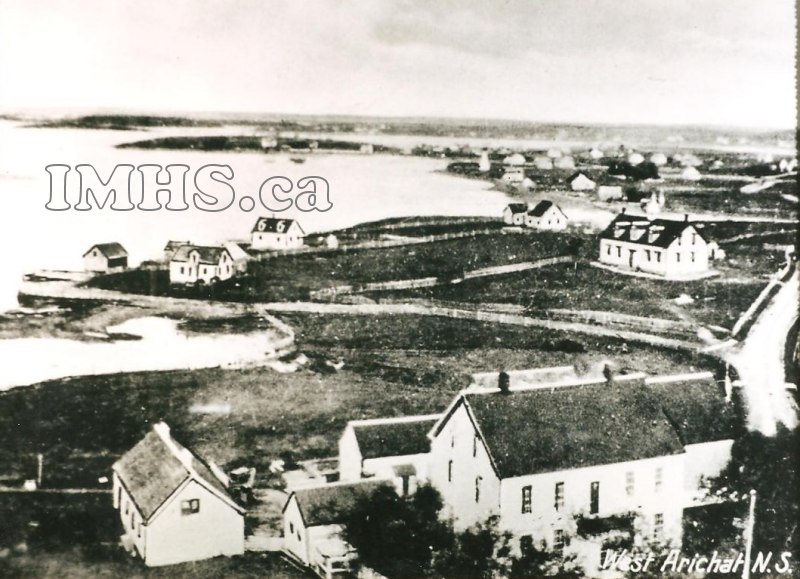
The largest grant of land awarded on Isle Madame between 1784-1794 was not to the Philip Robin and Company but to the Jersey company of Philip and Francis Janvrin for the 1000 acres of what became known as Janvrin Island. By 1796, according to British Home Office records, the Janvrin Company was the largest ship-owning firm on Isle Madame. The Janvrin grant is notable as all other grants were significantly smaller. Grants of 25 acres were the rule at Rocky Bay; grants averaged 100-200 acres in West Arichat; along the shores of the Arichat Harbour no grant was received for more than 100 acres and frontage was limited; in D'Escousse, grants averaged between 50-65 acres; grants at Petit de Grat were generally as small as 3-8 acres.

The Golden Age of Sail
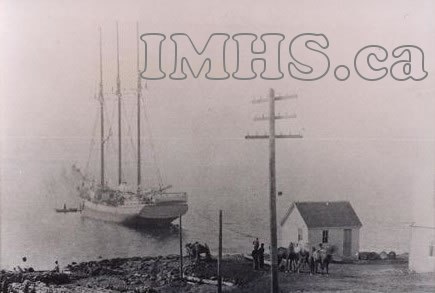
It was at this time, in the late 1700s, that the economy and people of Isle Madame began to prosper. By the 1830s, Arichat, blessed with its large deep harbour, had become the third largest mercantile port in Nova Scotia. Acadian, Jersey and Irish mariners, ship owners and merchants engaged in trade with ships moving through the Strait of Canso and through the St. Lawrence. They also actively moved dried fish and other products along the trade triangle from Cape Breton to the Caribbean to Europe and back. Ship building became a significant enterprise at Arichat, West Arichat and D'Escousse. As one account summarizes:
In Arichat alone in the 1830s upwards of 60 vessels a year were being constructed. Five forges were needed to supply the metal work necessary for these vessels. By 1867 over 400 vessels listed Arichat as their home port, hundreds more sailed out of West Arichat, D'Escousse, and Petit de Grat. So many Spanish, French and American vessels visited Arichat in those years the governments of those countries maintained consular agents at Arichat to look after the affairs of their nationals. By the 1860s Arichat could boast two high schools, a cathedral, two Protestant churches, a grand court house, 24 large wharves, several lawyers, several doctors, a Masonic temple, several hotels, up to four bars and a newspaper. Needless to say, this activity attracted a good deal of immigration to Isle Madame.
Decline and Renewal
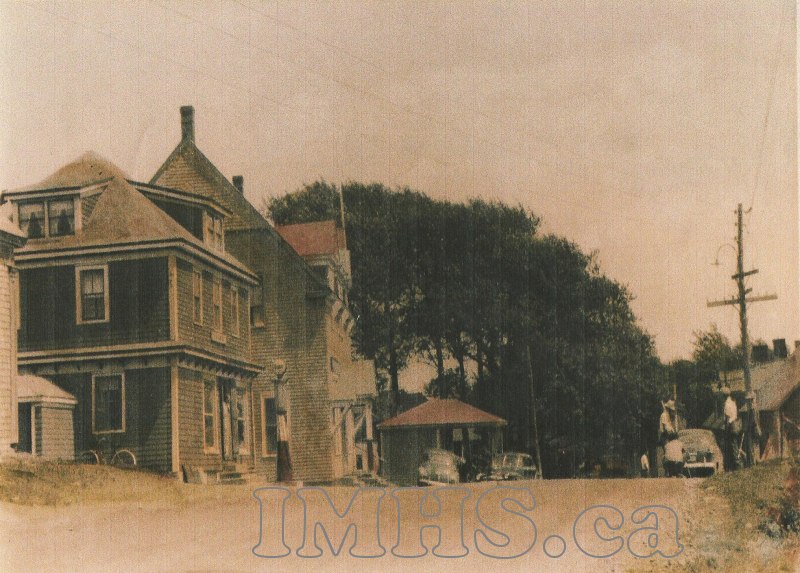
It wasn't until the 1870s, with the closing of the age of large sailing vessels, that Isle Madame began its slow decline in economic prominence and many in its population began to look for opportunity elsewhere in Canada and the United States. Over time, fishing again became Isle Madame's primary industry, with tourism also emerging as an important economic focus in the late twentieth century.
The current population of Arichat remains predominantly Acadian (70%), most of whom can trace their ancestry back more than 200 years on the Island. The majority of the community in Rocky Bay can trace their Irish ancestry in that area to the early 1800s. Descendants of the Channel Islanders can still be found on Isle Madame, though they are very much a minority of the population.
Trace your own Isle Madame roots
The Society's Genealogy Room, the Community Archives, and a guide to the best free online records are all a step away.